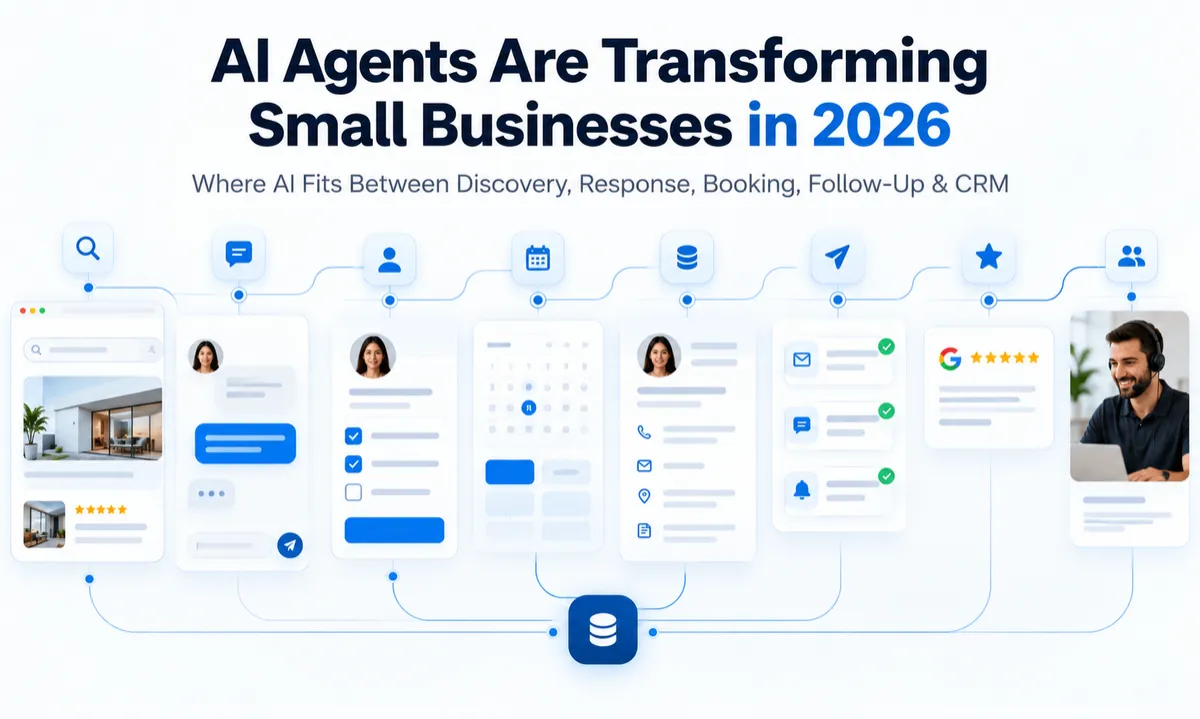
AI Agents Are Transforming Small Businesses in 2026
Automation & AI Agents · 2026
Getting found is only part of customer acquisition. Once someone calls, sends a message, fills out a form, or asks to book, the business still has to respond, understand what the customer needs, move the conversation forward, keep records organized, and follow up.
That is where automation—and, in the right situations, AI agents—can become useful.
The important distinction is that a small business does not need an AI agent for every task. Many workflows are better handled by ordinary automation. Others require conversational AI. A smaller group genuinely benefits from an agent that can interpret context, work within defined rules, use connected business systems, and determine an appropriate next action.
At Agency AI Lab, we look at these systems as part of a larger customer journey rather than as isolated AI tools. Visibility creates the opportunity. Trust helps earn the inquiry. Automation then helps the business handle what happens next.
Direct Answer
What Is an AI Agent for a Small Business?
An AI agent is a software system that can interpret a request or goal, use available context and connected tools, determine an appropriate next step within defined boundaries, and continue through multiple steps toward an outcome.
That does not mean unlimited autonomy. A well-designed business agent should have clear permissions, reliable information, defined escalation points, and limits on what it is allowed to say or do.
For example, a potential customer might ask whether a business serves a particular area and whether an appointment is available Friday afternoon. A capable system could interpret the request, reference approved service-area information, check scheduling availability, offer an appropriate time, record the conversation, and update the customer record.
That is materially different from a simple autoresponder that sends the same message every time a form is submitted.
18%
A 2026 U.S. Census Bureau working paper reported that 18% of firms used AI in a business function during the November 2025–January 2026 reference period. The number covers business AI broadly—not specifically AI agents—which is an important distinction when discussing adoption.
The Useful Distinction
AI Agent vs. Chatbot vs. Normal Automation
“AI automation” can describe several very different systems. Choosing the simplest system that can reliably perform the job usually makes more sense than adding intelligence where it is not needed.
Normal Automation
Best for predictable workflows where the same event should produce the same predefined action.
A missed call triggers a text. A completed appointment triggers a review request. A new form submission creates a CRM contact.
If the rule is “when X happens, always do Y,” ordinary automation may be enough.
Chatbot
Primarily provides a conversational interface. It may answer questions, collect information, or guide someone toward a next step.
Some chatbots are connected to deeper automation; others simply provide answers.
The presence of a conversation does not automatically make a system an AI agent.
AI Agent
More appropriate when the system must interpret context before choosing what should happen next.
It may use approved information, calendars, CRM records, communication tools, or other connected systems as it works toward a defined outcome.
If the system must understand what happened before deciding whether to do Y, Z, or something else, an agent may be appropriate.
OpenAI's guidance similarly distinguishes agents from simpler applications that use language models but do not let the model control workflow execution. Its agent guidance emphasizes tool use, multi-step workflows, guardrails, and the ability to transfer control when appropriate.
The Authority Tree
Where AI Agents Fit in the Customer Journey
The most useful way to understand an AI agent is not to start with the technology. Start with the customer.
Visibility → Trust → Contact → Response → Qualification → Booking → Follow-Up → CRM → Reviews
Agency AI Lab's Authority Tree starts before automation. Technical trust, a clear website, service and location pages, connected content, reputation signals, and useful information help people—and increasingly search and AI systems—understand what a business does.
But discovery is not the same thing as conversion.
Someone can find the right business and still encounter voicemail. They can submit a form and receive no response until tomorrow. They can ask a question after hours, intend to schedule, get distracted, and never come back.
The Automation & AI Agents and Conversion & Follow-Up branches address this second half of the journey. Their job is not to manufacture visibility. Their job is to help the business respond to the opportunities visibility creates.
This is why the current Agency AI Lab system connects the website and content layer with missed-call text-back, automatic follow-up, online booking, CRM and pipeline management, review requests, AI chat, and AI voice where appropriate.
Practical Applications
Where AI Agents Can Be Useful
The strongest use cases tend to appear where a business has recurring customer interactions but the correct next action depends on what the customer actually says or needs.
Lead Response
An agent can interpret an incoming inquiry, respond using approved business information, collect missing details, and determine whether the conversation should move toward qualification, scheduling, or a human employee.
Missed Calls & AI Voice
A simple missed-call text-back often requires only ordinary automation. AI becomes more useful when the caller wants to continue a conversation, ask questions, explain what they need, schedule, or be routed appropriately.
Lead Qualification
When qualification involves understanding different responses rather than collecting a fixed set of fields, an agent can help interpret the conversation and move qualified inquiries toward the correct next stage.
Appointment Scheduling
An agent can help when scheduling requires conversation around service type, location, availability, or other approved criteria. Straightforward booking links may need no AI at all.
CRM Updates
After a conversation, an agent may summarize what happened, capture useful customer information, update an appropriate CRM field or stage, and create a clearer record for the human team.
Follow-Up & Nurturing
Fixed follow-up sequences are often ordinary automation. AI becomes more relevant when the next communication should depend on the customer's reply, prior conversation, or current stage.
Customer Questions
Agents can handle common questions when they have an accurate, approved source of business information and know when an answer falls outside that information.
Internal Handoffs
A system can summarize conversations, create tasks, flag unusual requests, and route the interaction to the person best equipped to handle what comes next.
Review requests are another important part of the journey, but they usually illustrate why AI is not always necessary. If a completed job should reliably trigger the same approved review request, conventional workflow automation may be the cleaner solution.
Quick check: If a missed call should always trigger the same text, does the business need an AI agent?
Answer: No. A standard workflow is usually enough when the same event should always trigger the same action. An agent is more useful when the next step depends on interpreting the caller’s request.
The goal is not to put an AI agent everywhere. The goal is to remove the right friction at the right point in the customer journey—and use the simplest reliable system that can do the job.
Found First Connects Visibility to Follow-Up
Agency AI Lab builds and manages the website, content, booking, follow-up, CRM, review systems, and appropriate AI layers as one connected customer-acquisition system.
One Connected View
The Agent Is Only One Part of the System
The useful operating view is not a standalone AI window. It is a connected picture of conversations, appointments, pipeline stages, follow-up, and customer history so both automation and employees can understand what has already happened.
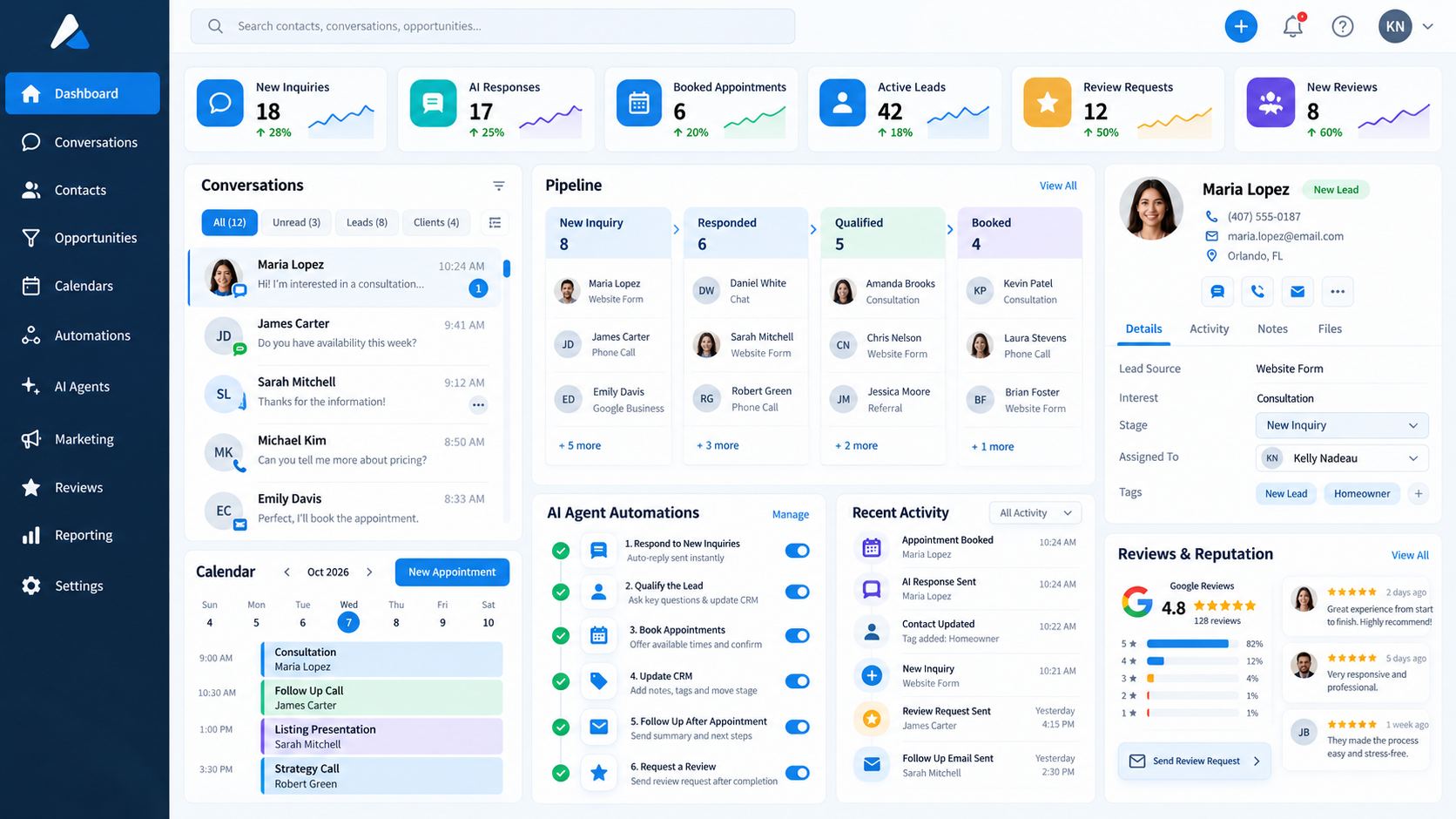
Editorial illustration of a small business CRM with conversations, appointments, follow-up and review activity; not a live customer dashboard.
Automation Strategy
What Should a Small Business Automate First?
The starting point should not be, “Where can we install AI?”
A better business question is: Where is a repeatable breakdown occurring between customer interest and the next useful action?
That might be slow lead response. It might be unanswered calls after hours. It could be repetitive scheduling, inconsistent qualification, customer information that never makes it into the CRM, forgotten follow-up, or review requests that happen only when someone remembers.
Once the bottleneck is clear, the right level of automation becomes easier to determine.
Use Automation When the Rule Is Predictable
Examples include confirmation messages, reminders, missed-call text-back, fixed follow-up sequences, basic CRM triggers, and review requests after a defined event.
Use an Agent When Context Changes the Next Step
Examples include conversational qualification, answering a request from approved knowledge, interpreting customer intent, deciding whether to book or escalate, and coordinating several connected actions.
This distinction also matters economically. An agent can introduce model usage, voice usage, system integrations, monitoring, and quality-control requirements that a simple workflow does not need. The more sophisticated technology should solve a correspondingly meaningful business problem.
The U.S. Small Business Administration similarly advises businesses considering AI to examine practical uses such as customer service while also considering risks and human review. Read OpenAI’s practical guide to agents.
Business Context
What Information Does an AI Agent Need?
An agent cannot accurately represent a business merely because it can hold a fluent conversation. It needs reliable information about the business it represents.
Depending on the use case, that may include:
services and specialties;
locations and service areas;
business hours;
appointment and scheduling rules;
frequently asked questions;
approved pricing information when appropriate;
business policies;
CRM stages and customer statuses;
escalation procedures;
required disclosures; and
claims the system is—and is not—authorized to make.
This connects directly back to the Authority Tree. Entity clarity is useful not only for a search engine trying to understand a business. Clear service, location, policy, and operational information also gives customer-facing systems a stronger factual foundation.
A polished AI voice does not compensate for inaccurate source information.
Guardrails Matter
Where Humans Still Matter
An agent should not be treated as permission to automate every conversation or decision.
The more sensitive, unusual, regulated, consequential, or emotionally complex the interaction becomes, the more important clear escalation and human oversight become.
Unexpected situations
Customers do not always follow a script. An unusual request, conflicting information, unclear intent, or exception to normal business policy can require a person who understands the broader situation.
Complaints and sensitive conversations
A frustrated customer may need judgment, empathy, negotiation, or authority that the agent was never intended to exercise.
Regulated or consequential decisions
Businesses in lending, housing, legal services, healthcare, financial services, and other regulated environments should be especially careful about what an automated system is allowed to say, recommend, collect, or decide.
Incomplete or unreliable information
If the underlying business information is wrong or missing, the safest next step may be escalation rather than an improvised answer.
Permissions and customer data
Agents connected to calendars, CRM records, communications, and other systems need appropriate permissions and data-handling practices. The Federal Trade Commission has repeatedly emphasized that companies remain responsible for representations about AI products and for honoring privacy and data-use commitments.
The NIST AI Risk Management Framework provides a useful broader framework for thinking about trustworthy AI, risk management, governance, measurement, and ongoing oversight.
What Businesses Are Asking in 2026
The Conversation Is Becoming More Practical
The discussion around AI agents is maturing. The useful questions are increasingly less about whether agents sound futuristic and more about whether they solve a specific operational problem reliably.
Useful questions to consider include:
Do I actually need an AI agent?
What should my business automate first?
How is an AI agent different from a chatbot?
How is an agent different from normal automation?
Can an AI agent respond to leads?
Can it book appointments?
Can it update the CRM?
Can it handle missed calls?
Where should a human take over?
What happens when someone asks something unexpected?
Are AI voice agents useful for small businesses?
How do we use AI without automating everything?
Is the additional cost justified?
What information does the system need before representing the business?
Useful questions for evaluating AI voice tools include CRM integration, appointment scheduling, human transfer, reliability and whether the system completes the intended task. These are editorial evaluation questions, not a measured industry survey.
That is a healthier direction for the category. Voice quality matters, but the harder operational questions are what happens after the conversation begins, where information comes from, what actions the system can take, how those actions are recorded, and when control returns to a person.
AI Visibility and AI Agents Are Different
There is also an important distinction between being understood by AI systems and using an AI agent inside the business.
AI visibility concerns whether search engines, answer engines, and customers can discover and correctly understand the business.
AI agents concern what the business can do with an inquiry, conversation, task, or workflow once action is required.
One helps create and support discovery. The other helps manage what happens after or around that discovery. A business can have sophisticated automation and still have a visibility problem. It can also have strong visibility and lose opportunities because nobody follows up.
Found First by Agency AI Lab
Getting Found Is Only the First Half
The Authority Tree connects visibility and trust with the systems that handle response, booking, follow-up, CRM, and reviews. Agency AI Lab builds and manages those layers as one system rather than leaving you with another collection of disconnected tools.
Frequently Asked Questions
AI Agents for Small Business: FAQ
Does my small business actually need an AI agent?
Not necessarily. If a workflow follows a predictable rule—when X happens, always do Y—ordinary automation may be simpler and more appropriate. An AI agent becomes more useful when context has to be interpreted before the system can determine the appropriate next step.
What is the difference between an AI agent and a chatbot?
A chatbot primarily provides a conversational interface. An AI agent can go further by using context, selecting from permitted actions or tools, and carrying a workflow through multiple steps. Some chatbots include agent-like capabilities, so the categories can overlap.
Can an AI agent respond to leads and book appointments?
Yes, when it is connected to the appropriate communication and scheduling systems and operates within defined business rules. Whether AI is necessary depends on how much interpretation the conversation requires; a simple booking workflow may not require an agent.
Can AI agents update a CRM?
They can be used to summarize conversations, add information to customer records, update permitted fields or stages, and create follow-up tasks when the CRM and agent system are appropriately connected. Those permissions should be deliberately limited and monitored.
Are AI voice agents useful for small businesses?
They can be useful where phone calls are an important customer channel and the system can accomplish something meaningful—such as answering approved questions, collecting information, qualifying an inquiry, booking an appointment, or transferring the caller. They are less compelling when every conversation ultimately requires immediate human judgment anyway.
Where should a human take over from an AI agent?
Human escalation is especially important when the system encounters uncertainty, exceptions, complaints, sensitive conversations, regulated matters, conflicting information, unusual customer requests, or decisions beyond its approved authority.
Continue Exploring
Related Agency AI Lab Articles
AI Workflow Automation: Why Businesses Are Replacing Manual Operations
AI Agents for Small Businesses in 2026
Why Growing Businesses Miss Opportunities
Trusted Resources
AgencyAILab.com · CertainlySold.net · FLHomesMagazine.com · ElderPlacement.agency · Smart-N-Loans.com
