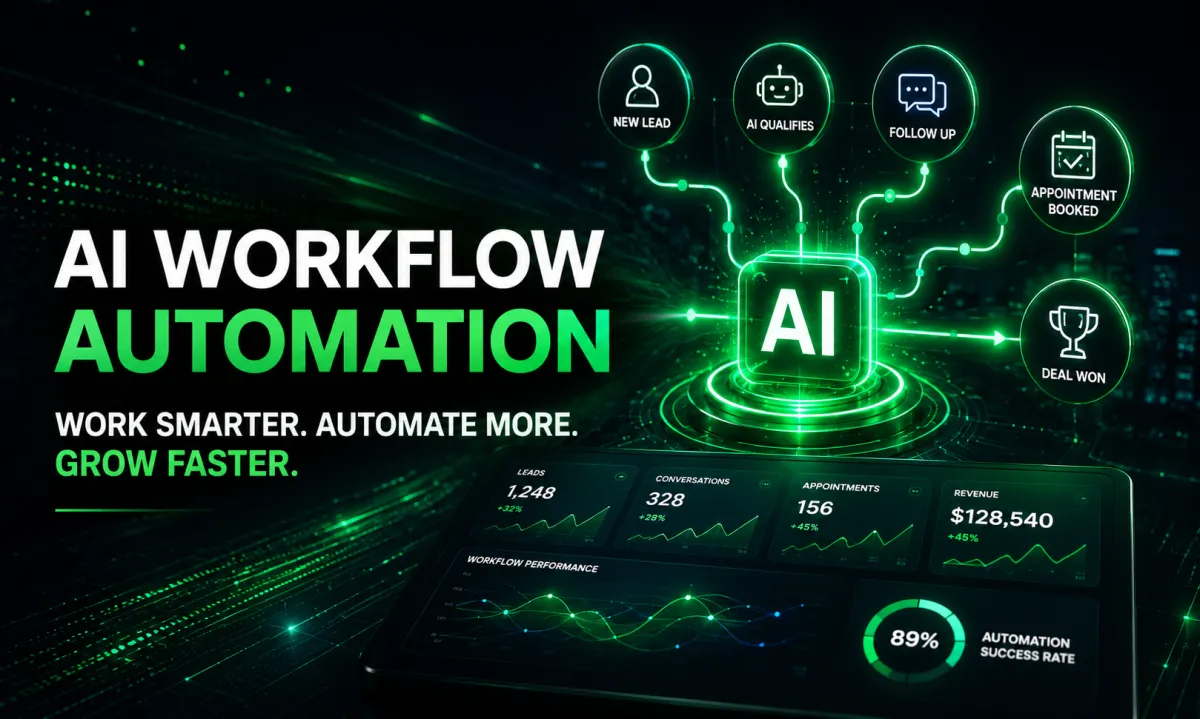
AI Workflow Automation: Why Businesses Are Replacing Manual Operations
Most businesses are not losing time because they lack software.
They are losing time because their workflows are fragmented.
A lead comes in through one platform.
Customer messages are handled somewhere else.
Scheduling lives in another system.
Follow-up is manual.
CRM updates are inconsistent.
Internal communication is disconnected.
Marketing workflows operate separately from operations.
And business owners end up spending enormous amounts of time managing repetitive tasks instead of focusing on growth.
That is exactly why AI workflow automation is becoming one of the fastest-growing trends in business operations in 2026.
Businesses are no longer looking for more disconnected tools.
They are looking for systems that:
automate repetitive work
connect operational workflows
improve speed
reduce manual tasks
streamline communication
improve customer response times
scale more efficiently
At Agency AI Lab, we’re seeing businesses rapidly shift toward AI workflow automation as operational efficiency becomes one of the biggest competitive advantages in modern business.
What Is AI Workflow Automation?
AI workflow automation combines:
artificial intelligence
automation systems
operational workflows
CRM integrations
communication systems
business process automation
to reduce repetitive manual work across an organization.
Unlike older automation systems that relied entirely on rigid triggers and fixed rules, modern AI workflows can:
interpret requests
analyze context
automate decisions
prioritize tasks
generate responses
manage multi-step workflows
interact across multiple platforms
This is a major shift from traditional automation.
Businesses are moving from:
isolated automations
to:
interconnected operational systems.
Why Businesses Are Prioritizing Workflow Automation
Most businesses today are overwhelmed by operational complexity.
Teams are constantly switching between:
CRMs
email platforms
scheduling tools
messaging systems
spreadsheets
project management tools
marketing software
customer support systems
The result is often:
slower operations
inconsistent follow-up
operational bottlenecks
duplicated work
missed opportunities
lower efficiency
AI workflow automation helps reduce that friction.
Businesses are increasingly adopting automation because they want:
operational leverage
scalability
consistency
faster execution
lower administrative workload
improved customer experience
The businesses implementing automation successfully are often operating significantly leaner than competitors still relying heavily on manual workflows.
The Shift From Task Automation to Workflow Automation
One of the biggest operational shifts happening right now is this:
Businesses are no longer automating only individual tasks.
They are automating entire workflows.
Older automation systems often handled:
single actions
isolated triggers
simple responses
Modern AI workflow systems can manage:
lead pipelines
customer communication
onboarding
appointment scheduling
CRM updates
reporting
follow-up sequences
internal workflows
marketing operations
This creates much larger operational efficiency gains.
Instead of automating one step, businesses are automating connected systems across the entire customer journey.
AI Workflow Automation for Lead Management
Lead management is one of the biggest use cases right now.
Businesses are using AI workflows to:
capture leads instantly
qualify inquiries
prioritize opportunities
automate follow-up
trigger scheduling workflows
update CRMs automatically
notify sales teams
reduce response times
Speed matters more than ever.
Businesses that respond faster often convert significantly more leads.
AI workflow systems help create that speed consistently.
AI Workflow Automation for Customer Communication
Customer expectations continue increasing.
People expect:
faster responses
instant communication
consistent follow-up
personalized interactions
AI workflow systems are helping businesses automate:
customer responses
appointment confirmations
reminders
support communication
onboarding sequences
lead nurturing
re-engagement campaigns
This improves:
efficiency
consistency
customer experience
operational scalability
without constantly increasing labor costs.
Why Businesses Are Consolidating Their Software Systems
One of the biggest trends in SaaS right now is consolidation.
Businesses are tired of:
disconnected tools
fragmented operations
app overload
workflow duplication
manual integrations
They want centralized operational systems.
This is one reason all-in-one business platforms and AI operating systems are growing so quickly.
Businesses increasingly want:
CRM systems
communication
scheduling
marketing
automation
reporting
AI workflows
inside one connected ecosystem.
The businesses simplifying operations often scale faster because operational friction is lower.
AI Workflow Automation for Agencies
Marketing agencies are among the fastest adopters of workflow automation.
Agencies are using AI systems for:
onboarding
reporting
lead management
proposal generation
client communication
SEO workflows
content systems
follow-up automation
The agencies growing fastest right now are often building operational leverage instead of continuously increasing staff.
This allows smaller teams to operate at much larger scale.
AI Workflow Automation for Local Businesses
Local businesses are rapidly adopting automation as competition increases.
Businesses using AI workflows often gain advantages in:
lead response speed
appointment booking
customer communication
operational consistency
follow-up systems
This is becoming especially valuable for:
contractors
med spas
real estate teams
mortgage companies
law firms
consultants
home service businesses
Many local businesses are discovering that operational speed alone can significantly impact revenue growth.
Why AI Workflow Automation Is Becoming a Competitive Advantage
The businesses benefiting most from automation are not necessarily the ones with the biggest budgets.
They are often the businesses:
simplifying operations
reducing friction
improving workflows
responding faster
building scalable systems
AI workflow automation creates leverage.
And operational leverage compounds over time.
Businesses operating efficiently often:
move faster
scale easier
improve customer experience
reduce administrative overhead
improve consistency
create stronger operational systems
Meanwhile, businesses relying heavily on manual processes may struggle to compete as customer expectations continue rising.
The Role of AI Search Optimization in Workflow Automation
AI search optimization is also beginning to influence workflow strategy.
Businesses are increasingly creating workflows around:
conversational search
AI-generated answers
AI visibility
content automation
entity-based SEO
structured content systems
This is changing how businesses approach:
marketing
lead generation
content workflows
customer discovery
Businesses exploring AI visibility strategies and operational automation systems can learn more at Agency AI Lab Blog.
Common Mistakes Businesses Make With Workflow Automation
Mistake #1: Automating Broken Processes
Automation does not fix poor workflows.
Businesses should simplify operations before heavily automating them.
Mistake #2: Using Too Many Platforms
Many businesses create unnecessary complexity by stacking disconnected software tools.
The businesses scaling most efficiently are often simplifying systems rather than endlessly adding more tools.
Mistake #3: Ignoring Human Oversight
AI workflow automation still benefits from human review and operational oversight.
The strongest businesses use AI to enhance operations rather than completely remove strategic decision-making.
Responsible Automation Matters Too
As businesses automate more operational processes, they should also think about responsible AI implementation, governance, and long-term operational reliability.
The National Institute of Standards and Technology (NIST) AI Risk Management Framework provides guidance around trustworthy AI systems, governance strategies, and responsible AI implementation as businesses increasingly integrate AI into operational workflows and automation systems.
The Businesses That Will Win Over the Next Few Years
The businesses most likely to scale successfully with AI workflow automation are usually not the ones chasing every trend.
They are the businesses that:
simplify operations
automate strategically
improve customer experience
build scalable systems
reduce repetitive work
improve workflow efficiency
adapt quickly
AI workflow automation is becoming less about novelty.
And more about operational infrastructure.
Final Thoughts
AI workflow automation is rapidly becoming one of the biggest operational shifts happening across modern business.
Businesses are moving away from disconnected tools and repetitive manual processes toward:
connected systems
operational automation
scalable workflows
AI-powered infrastructure
The biggest opportunity is not replacing people.
It is removing operational bottlenecks so businesses can focus more on:
growth
relationships
customer experience
execution
scalability
The businesses implementing workflow automation strategically today may operate significantly faster and more efficiently than competitors still relying heavily on manual operations over the next several years.
Ready to Build Smarter AI-Powered Workflows?
Businesses gaining the biggest operational advantage right now are the ones building automation systems before workflow automation becomes standard everywhere else.
If you want to improve operational efficiency, automate repetitive tasks, streamline workflows, and create scalable AI-powered business systems, now is the time to start implementing smarter automation strategically.
Explore AI-powered automation tools and business workflow systems here:
Explore AI-Powered Business Automation
You can also explore additional AI automation strategies, AI search optimization insights, and operational workflow systems at Agency AI Lab