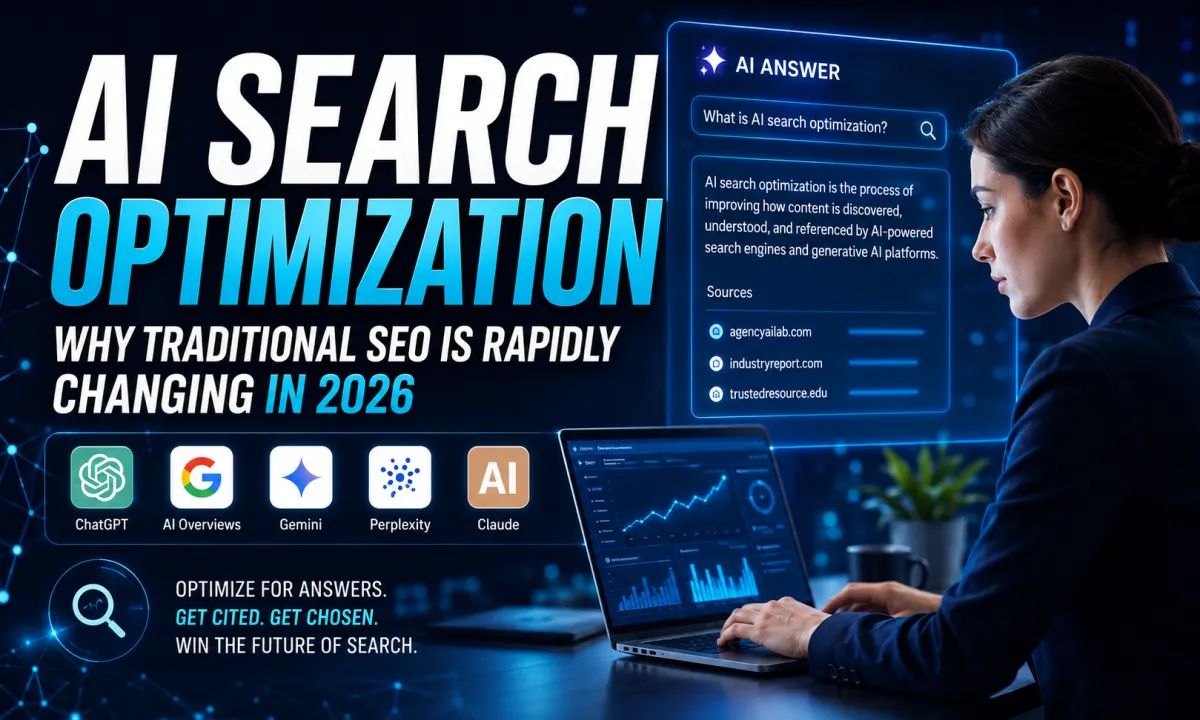
AI Search Optimization Is Reshaping SEO in 2026
Most businesses still think SEO is about ranking pages on Google.
That mindset is becoming outdated faster than most companies realize.
Search is changing.
And it is changing because AI is fundamentally reshaping how people discover information online.
Businesses are no longer competing only for:
blue links
organic rankings
traditional search traffic
They are now competing for visibility inside:
ChatGPT
Google AI Overviews
Gemini
Perplexity
Claude
AI answer engines
This shift is creating one of the biggest transformations in digital marketing in over a decade.
At Agency AI Lab, we’re watching businesses rapidly realize that traditional SEO strategies alone are no longer enough to maintain visibility in an AI-driven search environment.
The businesses adapting early to AI search optimization may have a major advantage over competitors still relying entirely on legacy SEO tactics.
What Is AI Search Optimization?
AI search optimization is the process of improving how businesses appear inside AI-generated answers and conversational search systems.
Unlike traditional SEO, where users click through lists of links, AI search systems increasingly summarize information directly inside the search experience.
That changes everything.
Instead of competing only for rankings, businesses now need to optimize for:
AI citations
entity recognition
structured information
conversational search
authority signals
contextual relevance
answer generation systems
This category is often being called:
AI Search Optimization
Generative Engine Optimization (GEO)
Answer Engine Optimization (AEO)
Regardless of the label, the shift is very real.
Research around AI search systems shows that AI-generated search experiences are increasingly appearing above traditional search results and changing how websites receive traffic and visibility.
Why Traditional SEO Alone Is No Longer Enough
For years, SEO focused heavily on:
keywords
backlinks
metadata
technical optimization
rankings
Those factors still matter.
But AI search systems are changing how information is surfaced.
Instead of only returning pages, AI systems increasingly generate:
summaries
direct answers
recommendations
conversational responses
synthesized information
Google AI Overviews are one of the clearest examples of this shift.
Many informational searches now generate AI summaries before users even see traditional organic listings.
That means businesses now need visibility inside the answer itself.
Not just below it.
The Rise of AI Overviews Is Reshaping Visibility
Google’s AI Overviews are rapidly changing search behavior.
Businesses that previously depended on informational search traffic are now seeing:
fewer clicks
lower visibility
changing engagement patterns
reduced traffic from top-of-funnel searches
Meanwhile, businesses being referenced directly inside AI-generated answers are gaining disproportionate visibility.
This creates a completely different competitive landscape.
The businesses winning visibility in AI search are increasingly:
highly authoritative
entity-rich
well-structured
conversationally optimized
frequently cited
contextually relevant
Research into AI search ecosystems shows that AI-generated search experiences retrieve and display information differently than traditional search engines.
That means older SEO playbooks are becoming less reliable on their own.
Why AI Search Optimization Is Becoming So Important for Businesses
Businesses are slowly realizing something critical:
ranking #1 no longer guarantees visibility.
If AI systems answer the question directly, users may never scroll to traditional search results.
That is why businesses are increasingly focusing on:
AI visibility
citation optimization
entity authority
conversational content
structured answers
semantic relevance
The shift is happening rapidly across:
SaaS companies
agencies
local businesses
publishers
eCommerce brands
consultants
service businesses
This is no longer a niche SEO discussion.
It is becoming a core business visibility strategy.
How AI Search Engines Decide What to Surface
AI systems rely heavily on:
entity relationships
trusted sources
contextual relevance
structured content
conversational clarity
authority signals
semantic understanding
This is very different from older keyword-focused SEO models.
AI systems increasingly prioritize content that is:
easy to summarize
well organized
factually clear
topically authoritative
conversationally structured
That is why businesses using outdated SEO tactics alone are struggling to maintain visibility in AI-driven search environments.
The Businesses Getting Cited Most Often
AI systems tend to favor content that demonstrates:
expertise
topical authority
clarity
trust signals
freshness
structured formatting
One major trend emerging right now is the growing importance of trust and reputation signals.
Businesses with stronger review profiles and stronger online authority are increasingly appearing more often inside AI-generated answers.
This means visibility is no longer only about rankings.
It is increasingly about:
reputation
authority
semantic trust
brand recognition
entity consistency
Why Conversational Content Matters More Than Ever
AI search engines process information differently than traditional search crawlers.
Modern AI systems are heavily optimized for:
conversational understanding
natural language processing
semantic interpretation
contextual reasoning
That means businesses now need content written in ways AI systems can easily:
interpret
summarize
cite
contextualize
The businesses succeeding in AI search are increasingly producing content that is:
highly readable
conversational
direct-answer focused
logically structured
entity-rich
topically deep
This is one reason low-quality AI spam content is becoming less effective.
AI systems increasingly reward:
clarity
authority
structure
expertise
usefulness
AI Search Optimization Is Changing Content Strategy
The content strategies that worked five years ago are no longer enough.
Businesses now need content designed for:
AI summaries
conversational discovery
semantic indexing
entity relationships
answer generation systems
That changes how businesses approach:
blogs
landing pages
FAQs
topical clusters
schema structure
internal linking
authority building
At Agency AI Lab Blog, we’re actively tracking how AI search optimization is reshaping modern SEO, content systems, and business visibility strategies.
The Rise of Entity-Based SEO
One of the biggest shifts happening right now is the move toward entity-driven search.
AI systems increasingly evaluate:
people
businesses
brands
locations
products
services
concepts
as connected entities rather than isolated keywords.
This means businesses need stronger:
brand consistency
topical authority
semantic relevance
content depth
cross-platform recognition
The future of visibility is becoming increasingly entity-based rather than keyword-only.
Why AI Search Optimization Is a Massive Opportunity Right Now
Most businesses are still behind.
That creates opportunity.
Very few companies currently understand:
AI visibility optimization
answer engine optimization
AI citation strategies
semantic authority building
AI search behavior
The businesses adapting early may gain:
disproportionate visibility
stronger authority
earlier AI citations
long-term search advantages
stronger brand recognition
This feels very similar to the early days of SEO before most businesses understood search optimization.
The difference is that AI search is evolving even faster.
Common Mistakes Businesses Are Making Right Now
Mistake #1: Treating AI Search Like Traditional SEO
AI search systems operate differently.
Businesses relying entirely on older SEO strategies may lose visibility as AI-generated answers continue expanding.
Mistake #2: Publishing Thin AI Content
Low-quality AI-generated content is becoming easier for AI systems to recognize.
The businesses succeeding are combining:
AI efficiency
human expertise
strong editing
topical authority
deep content structure
Mistake #3: Ignoring Entity Authority
Many businesses still focus only on keywords.
But AI systems increasingly evaluate:
brand authority
contextual trust
entity relationships
semantic consistency
Businesses that ignore entity optimization may struggle with AI visibility long term.
Why Human Expertise Still Matters
One of the biggest misconceptions right now is that AI search removes the need for human expertise.
In reality, authoritative human-guided content is becoming even more important.
AI systems still rely heavily on:
trusted information
authoritative sources
clear expertise
structured knowledge
The businesses building real authority may become increasingly valuable as AI-generated search continues evolving.
Responsible AI and Search Governance Matter Too
As AI search systems expand, businesses should also pay attention to responsible AI implementation, transparency, and information reliability.
The National Institute of Standards and Technology (NIST) AI Risk Management Framework provides guidance on trustworthy AI systems, governance considerations, and long-term AI implementation best practices.
As AI-generated search continues evolving, businesses that prioritize trustworthy, authoritative content may have stronger long-term positioning.
The Businesses That Will Win in AI Search
The businesses most likely to succeed are usually not the ones chasing shortcuts.
They are the businesses that:
build real authority
create structured content
improve semantic clarity
establish entity trust
publish useful information
strengthen topical relevance
adapt quickly to AI-driven discovery
AI search optimization is not replacing SEO.
It is evolving it.
And that evolution is happening much faster than most businesses expected.
Final Thoughts
AI search optimization is rapidly becoming one of the most important shifts in digital visibility.
Businesses are no longer competing only for rankings.
They are competing for:
AI citations
answer visibility
semantic authority
conversational relevance
entity trust
The businesses adapting early may have a major long-term advantage as AI-generated search becomes increasingly dominant across search platforms.
Meanwhile, businesses relying entirely on outdated SEO tactics may struggle to maintain visibility in a rapidly changing search landscape.
The future of search is becoming increasingly conversational, contextual, and AI-driven.
And businesses that understand that shift early may move much faster than competitors still optimizing for the internet of the past.
Ready to Build Visibility for the Future of Search?
The businesses gaining the biggest visibility advantage right now are the ones adapting before AI search becomes fully mainstream.
If you want to improve AI visibility, optimize for AI search engines, streamline content systems, and build smarter digital growth strategies, now is the time to start evolving your SEO approach.
Explore AI-powered business growth systems and automation tools here:
You can also explore additional AI automation and AI search optimization strategies at Agency AI Lab
