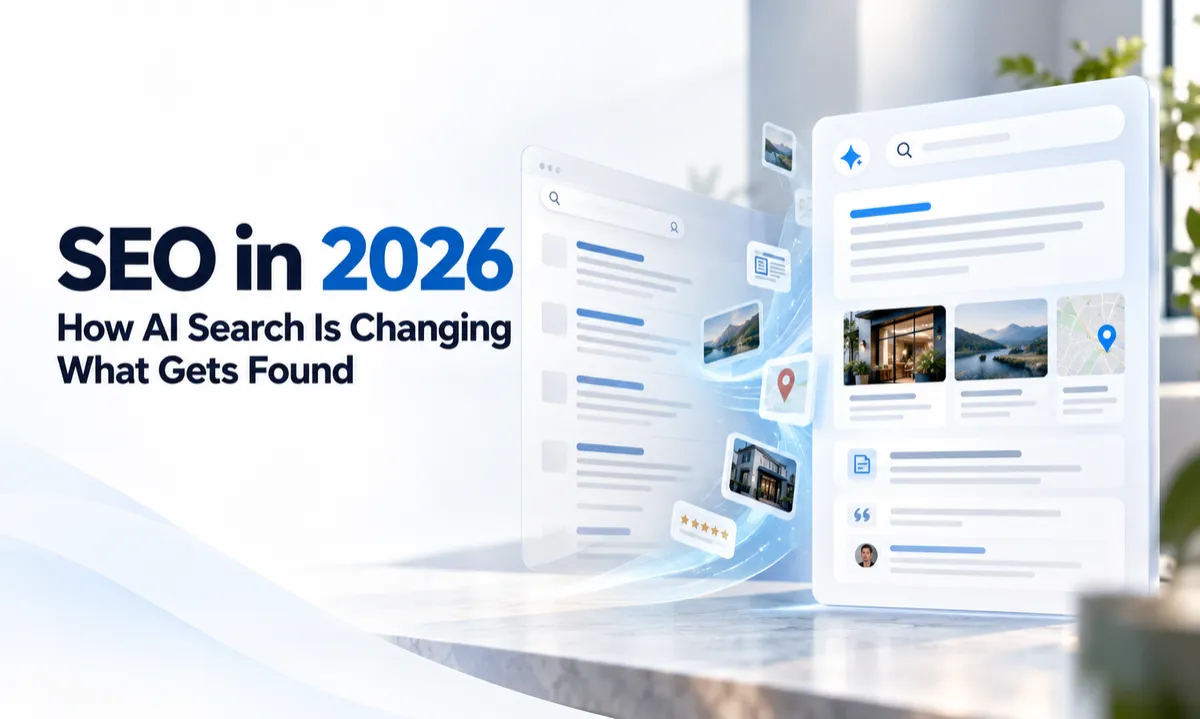
SEO in 2026: How AI Search Is Changing Google
Agency AI Lab · Search & AI
SEO is not dead. But the search experience around it is changing quickly.
Google now blends traditional search results with AI Overviews, AI Mode, conversational follow-up, richer source links, and increasingly complex queries.
For businesses, the question is no longer whether to choose SEO or AI search optimization. The useful question is how the same strong foundation can support visibility across both.
Is Traditional SEO Dead in 2026?
Short Answer
No. Google explicitly says its generative AI features are rooted in its core Search ranking and quality systems, which means foundational SEO remains relevant.
What has changed is the search experience: people can ask longer questions, receive synthesized answers, follow up conversationally, and discover sources without following the familiar ten-blue-links path.
That distinction matters because the phrase “SEO is dead” makes the change sound cleaner than it really is.
Search did not discard relevance, useful content, technical accessibility, links, page quality, or clear information.
Instead, Google added new ways of interpreting questions and presenting information on top of its established search systems.
Google describes AI Overviews and AI Mode as using techniques such as retrieval-augmented generation and query fan-out while still relying on core Search systems to retrieve useful web content.
Google’s current generative AI search guidance makes that relationship unusually clear.
2.5B+
In its June 3, 2026 announcement, updated August 31, Google reported that AI Overviews had more than 2.5 billion monthly active users, while AI Mode had surpassed one billion. The scale makes AI-assisted search important—but not evidence that conventional search has disappeared.
Source: Google, June 3, 2026; updated August 31, 2026
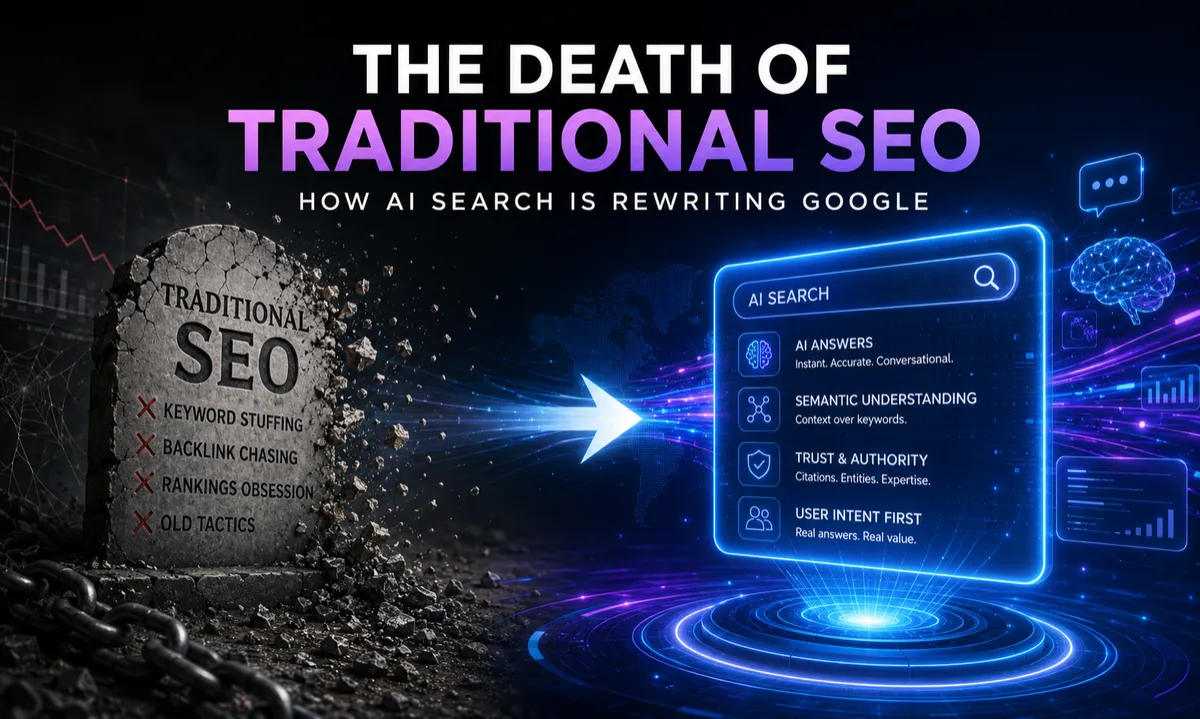
Editorial illustration of search concepts; it is not a live analytics screenshot or performance result.
What Actually Changed
Search Is Becoming More Conversational
A traditional query might contain two or three words. An AI-assisted query can contain the problem, context, constraints and follow-up questions in a single conversation.
Google says AI Mode users are asking longer, more complex questions and exploring subjects in greater depth.
That creates a different experience for the user—even when the information underneath still comes from search systems, websites and other sources.
What Traditional SEO Still Gets Right
One of the weaknesses in early “AI SEO” commentary was the assumption that everything associated with traditional SEO had suddenly become obsolete.
That is not what current platform guidance shows.
Search intent still matters
A page still needs to satisfy what the person is trying to understand, compare, find or accomplish.
Useful content still matters
Google continues to emphasize original, substantial, people-first information rather than content created primarily to manipulate rankings.
Technical quality still matters
Search systems still need to understand pages, links, site structure, page relationships and the information presented to users.
Authority still matters
Reputation, useful references, expertise and trustworthy supporting information remain valuable even though no single authority metric explains every search result.
Keywords have not vanished either. What has changed is the wisdom of treating an exact keyword phrase as if it represents the entire customer need.
Modern search is better understood around topics, intent, relationships and questions—not simply repeated phrases.
The useful shift is not from SEO to AI. It is from optimizing a page for one ranking position to making the entire business easier to understand, trust and discover.
Agency AI Lab
Build for the Way Customers Search Now
Agency AI Lab helps businesses create clearer websites, stronger content and connected digital systems designed for modern search and AI-assisted discovery.
Visibility Has More Than One Surface
Rankings Are Still Useful—but They Are No Longer the Whole Picture
Businesses can now think about visibility across conventional search results, AI-assisted answers, branded discovery, local results, cited sources and the quality of the traffic that eventually reaches the website.
SEO, AEO and GEO: Three Labels, One Overlapping System
The terminology around AI search became crowded quickly.
SEO
Search Engine Optimization
Improving a site's ability to be understood, ranked and discovered in search.
AEO
Answer Engine Optimization
Emphasizing clear, useful information that can support direct answers to specific questions.
GEO
Generative Engine Optimization
A term used for improving visibility when generative systems synthesize responses from multiple sources.
AIEO
AI Engine Optimization
A broader editorial label for making businesses and content easier for AI-assisted discovery systems to interpret.
These should not be treated as four unrelated marketing programs.
Google itself says that from its perspective, optimizing for generative search remains part of SEO.
The additional labels are most useful when they help teams think about different outcomes: ranking, answering, citation, brand recognition and machine-readable clarity.
What Businesses Should Change in 2026
Answer the real question early. Do not make a reader dig through six paragraphs before discovering the point.
Build depth around real areas of expertise. A connected body of useful material is more valuable than dozens of unrelated posts created because a keyword tool produced them.
Clarify entities. Clearly identify the company, services, products, locations, expertise and relationships that matter to the page.
Use descriptive internal links. Help people and systems understand how services, topics and supporting resources relate.
Add real evidence. First-hand examples, original analysis, photographs, documented processes and credible sources create information that generic summaries cannot easily replace.
Keep structured data accurate. Schema can help systems understand page information, but it should describe visible content rather than act as a bag of hidden keywords.
Design for humans first. Short paragraphs, clear headings, comparison tables and concise answers help both readers and information retrieval systems.
For a broader discussion of why good businesses can still be overlooked, see Why Great Businesses Become Invisible .
What Not to Do
Do not replace sound SEO with an “AI optimization” checklist built on guesses.
No agency controls whether Google, ChatGPT, Gemini, Perplexity or another AI system will cite or recommend a particular business.
Avoid vendors promising guaranteed AI rankings, guaranteed citations or secret markup that supposedly bypasses normal search quality systems.
The Federal Trade Commission's AI resources are also a useful reminder that AI-related marketing claims should be accurate and supportable.
What Business Owners Are Asking Right Now
Questions worth asking about modern search include:
Is SEO dead because of AI?
Does SEO still matter for Google AI Overviews?
What is the difference between SEO, AEO and GEO?
How do I optimize content for AI search?
Can my website rank in Google but not appear in an AI answer?
Should I optimize differently for ChatGPT and Google?
Are backlinks still important?
Do keywords still matter in conversational search?
These are editorial questions for evaluating the topic, not measured search-volume or private AI-chat data.
Where Search Appears to Be Heading
The strongest trend is not the disappearance of websites.
It is the expansion of the layer between the question and the click.
Google is increasingly capable of interpreting longer, multimodal and conversational requests, synthesizing information, and helping users continue researching through follow-up questions.
Google also continues adding prominent links and source discovery inside its AI search experiences, which means original websites still have a role in the system.
The opportunity for businesses is to become useful enough to deserve discovery wherever that journey begins.
Search Changed. The Fundamentals Did Not Disappear.
Build a digital presence that explains what your business does, answers the questions customers actually ask and gives both people and modern discovery systems something worth finding.
Frequently Asked Questions
Is traditional SEO dead in 2026?
No. Google explicitly says established SEO best practices remain relevant to its generative search features because AI Overviews and AI Mode rely on core Search ranking and quality systems. What is changing is how search results are assembled and presented.
What is the difference between SEO and AEO?
SEO broadly focuses on search visibility. Answer engine optimization, or AEO, emphasizes structuring useful information so it can answer specific questions clearly. In practice, the two overlap substantially.
What is GEO?
GEO stands for generative engine optimization. It is commonly used to describe work intended to improve visibility in generative AI responses. Google does not describe GEO as a replacement for SEO and says optimization for its own generative Search experiences remains part of SEO.
Do keywords still matter in AI search?
The words people use still communicate intent and subject matter, so keywords remain useful. The difference is that modern search can interpret broader meaning, context and related concepts, making exact-match repetition less useful than clear topical coverage.
Are backlinks still important?
Links remain part of Google's search ecosystem, but no responsible strategy should reduce modern SEO to acquiring backlinks alone. Helpful content, relevance, site quality, internal structure, authority and user needs all matter.
Can a company guarantee that AI will recommend my business?
No. Businesses and agencies do not control the ranking, citation or recommendation systems operated by Google, OpenAI or other AI platforms. The responsible goal is to improve clarity, relevance, credibility and discoverability without promising a particular placement.
Related Agency AI Lab Articles
Why Great Businesses Become Invisible
Agency AI Lab publishes practical guidance on AI-assisted discovery, modern search, business visibility and the systems that connect attention to customer action.
Trusted Resources
AgencyAILab.com · CertainlySold.net · FLHomesMagazine.com · ElderPlacement.agency · Smart-N-Loans.com
