
Mortgage CRM Guide 2026: Automation, LOS & AI
Mortgage CRM Strategy · 2026
A mortgage CRM should not be judged by how many features appear on its pricing page. It should be judged by whether it fits the way your business actually handles inquiries, borrower communication, long-term follow-up, referral relationships, appointments and handoffs into the loan process.
Getting a mortgage lead is only the beginning. Someone still has to respond, understand what the prospect needs, schedule the right conversation, keep the relationship organized, follow up over time and know when the interaction belongs with a licensed mortgage professional rather than an automated system.
That makes CRM selection an operational decision rather than simply a software comparison.
Found → Inquiry → Response → Qualification → Consultation → Application / LOS → Follow-Up → Closing → Long-Term Relationship
That progression also explains where CRM fits inside the broader Agency AI Lab Found First system. Website visibility and content can help a mortgage professional become easier to find and understand. CRM, booking, text-back, follow-up and automation help organize what happens after someone raises a hand.
Direct Answer
What Does a Mortgage Broker Actually Need From a CRM?
A useful mortgage CRM should give the business a reliable view of the relationship before, during and after a loan opportunity without trying to replace the systems responsible for the actual mortgage file.
For many independent brokers and loan officers, that means lead-source tracking, conversation history, pipeline visibility, scheduling, borrower nurture, referral-partner organization, task management, automation, appropriate permissions and a workable connection to the existing mortgage technology stack.
Some businesses need a mortgage-specific CRM with deeper LOS connectivity and industry workflows. Others already have an LOS they like and need a stronger system around lead capture, texting, email, calendars, missed-call response, websites and long-term nurturing.
That distinction matters because the system with the deepest mortgage workflow is not automatically the system with the most flexible marketing automation—and the most flexible automation platform is not automatically the right place to manage a mortgage file.
Know the Boundary
CRM ≠ LOS
CRM: relationships, communications, leads, referral partners, appointments, nurturing, pipeline visibility and marketing workflows.
LOS: the mortgage origination and loan-file workflow used to manage the actual loan process.
CRM vs. LOS: Know the Difference Before You Buy
Mortgage software descriptions sometimes make these categories sound interchangeable. They are not.
A CRM generally manages the relationship around a prospect, borrower, past client or referral partner. It helps answer questions such as: Where did this lead come from? What has already been discussed? Has a consultation been scheduled? What follow-up is appropriate? Who owns the next task? When should we reconnect?
A loan origination system manages the mortgage workflow itself. That is where mortgage businesses typically expect loan-level processes, file status, origination data and other information associated with the mortgage transaction to live.
Some mortgage technology products cross these boundaries or add point-of-sale, borrower portal, document or marketing functions. The practical question is not whether one vendor claims to do everything. It is which system owns which record, which system triggers which action, and how information moves between them.
Current mortgage CRM platforms such as BNTouch, Aidium, Shape and Jungo document connections with major loan origination systems. The exact integration method, available fields, direction of data flow and supported workflows vary by vendor and LOS, so those details should be verified for the specific mortgage stack before purchase.
Before Comparing Features
7 Questions to Ask Before Choosing a Mortgage CRM
1. Where do inquiries come from?
Website forms, paid advertising, Realtors, builders, past clients, inbound calls and purchased leads can all enter differently. The CRM should make the source visible without forcing the team to reconstruct it later.
2. What happens immediately after an inquiry?
Decide whether the business needs a simple acknowledgment, a booking path, a task for a loan officer, an after-hours response or a more contextual conversation. Not every first response requires AI.
3. How long do relationships need to stay active?
Mortgage prospects may be searching for a home, improving credit, saving, comparing financing options or waiting for the right timing. A CRM should support continuity when the relationship is not ready to move immediately.
4. How should the CRM interact with the LOS?
Verify which records move between systems, whether the connection is one-way or two-way, which milestones are available, what triggers updates and what happens when information changes. “Integrates with” can mean very different things from one vendor to another.
5. What communication should be automated?
Appointment reminders and basic acknowledgments are different from discussing loan terms, evaluating a borrower situation or responding to a complex financing question. Automation should have a defined job rather than an unlimited mandate.
6. Where must a human take over?
Licensed-professional involvement, unusual borrower circumstances, complaints, questions about specific loan terms and decisions that could affect access to credit require much more care than routine scheduling or administrative communication.
7. Will the team actually use it?
A sophisticated platform that creates more manual work can become another source of fragmented data. Usability, mobile access, clear ownership, permissions and fit with the existing process matter alongside feature depth.
The right mortgage CRM is not the system with the most automation. It is the system that gives the right person—or the right workflow—the context needed for the next appropriate action.
Business Fit
Mortgage-Specific CRM vs. General Automation CRM
The most important CRM decision may be the category you choose before you compare individual products.
Mortgage-Specific Platforms
Mortgage-focused systems may provide deeper industry terminology, LOS connections, mortgage-oriented workflows, lending-specific marketing tools, referral-partner functions and enterprise controls designed around lenders and originators.
They can make sense when the CRM needs to stay closely aligned with the mortgage production environment.
General Automation Platforms
Broader sales and marketing platforms may provide greater flexibility around websites, funnels, forms, calendars, texting, email, workflows, AI communication, reputation management and cross-channel automation.
They can make sense when the main operational problem is lead management and communication rather than mortgage-file processing.
Current Platforms Worth Understanding
The following is not a ranking. Each represents a different operating model, and current capabilities should be verified against the specific LOS, team structure and compliance requirements of the business.
Platform | Where It May Fit | What to Verify |
|---|---|---|
HighLevel | Independent brokers or teams prioritizing CRM, websites, forms, calendars, texting, email, calling, workflows, pipelines, reputation tools and AI-assisted communication. | Mortgage-specific LOS connectivity, borrower-data boundaries, compliance configuration and whether the business needs deeper mortgage-native workflow functionality. |
BNTouch | Mortgage businesses wanting a mortgage-focused CRM with documented connections to systems including Encompass, LendingPad, Calyx, Byte and MeridianLink, along with borrower and partner communication and marketing automation. | Exact LOS behavior, field availability, sync direction, prerequisites, implementation scope and current commercial terms. |
Aidium | Mortgage organizations looking for mortgage-focused CRM, marketing, reporting, automation and connections with platforms including Encompass, ARIVE, LendingPad and Byte. | Which integrations are native, API-based or connected through another service; team permissions; implementation requirements; and current commercial terms. |
Shape | Mortgage teams wanting CRM, communication, referral tracking and automation around an existing mortgage stack. Shape documents integrations with mortgage platforms including Encompass, LendingPad and LendingDox, with additional connections available through other methods. | Integration method, supported LOS or POS system, workflow ownership, migration scope and current pricing. |
Total Expert | Larger lenders and financial institutions needing enterprise customer engagement, lead management, marketing orchestration, customer intelligence and organizational controls. | Enterprise implementation requirements, integrations, governance, administration resources and commercial terms. |
Jungo | Mortgage organizations that want mortgage-oriented CRM functionality. Verify its current Salesforce arrangement and supported LOS connections directly with Jungo. | Salesforce requirements, LOS Sync configuration, administration resources, implementation effort, contract terms and total platform cost. |
Readers who are ready for a more direct product comparison can continue to Agency AI Lab's HighLevel review.
Define the System Before Choosing the Software
If you are comparing platforms, start with the work your mortgage business needs the CRM to handle: inquiry response, appointment booking, long-term nurture, referral relationships, communication history, LOS handoffs and team accountability.
Where HighLevel Fits
Is GoHighLevel a Mortgage CRM?
HighLevel is a broad sales, marketing and automation platform. It is not a mortgage-specific loan origination system, and it should not be described as the authoritative mortgage loan file merely because a mortgage business uses it as a CRM.
Its platform currently includes CRM and pipelines, unified conversations, email and SMS marketing, calling, workflow automation, forms, surveys, websites and funnels, booking calendars, reputation management and multiple AI tools.
That combination may make HighLevel attractive when a mortgage professional's larger problem is the system surrounding the mortgage process:
capturing inquiries from websites and landing pages;
organizing prospects in a sales pipeline;
supporting missed-call follow-up;
managing text and email communication;
booking consultations;
maintaining longer-term nurture;
tracking communication history;
requesting reviews at an appropriate point;
using AI for approved conversational or administrative tasks; and
reducing the number of separate marketing tools used around the CRM.
The tradeoff is specialization. A mortgage-native platform may provide deeper LOS connectivity, preconfigured mortgage workflows, mortgage-specific content or enterprise lender controls with less customization.
HighLevel therefore makes the most sense to evaluate as the relationship, communication and automation layer around the mortgage operation, not as a blanket replacement for the LOS.
Mortgage Technology Stack
How the CRM Fits Into the Mortgage Technology Stack
A mortgage CRM does not need to become the system of record for the loan file. Its primary role is to organize the relationship around the borrower or referral source: where the inquiry came from, what has already been discussed, what follow-up is due, whether a consultation is scheduled, and when the opportunity should move into the loan origination process.
A clearer mortgage technology stack separates those responsibilities instead of forcing every task into one platform.
The CRM may coordinate website inquiries, calls, texts, email, calendars, lead stages, referral relationships, follow-up tasks and appropriate AI-assisted communication. Once the relationship moves into the mortgage origination process, the LOS serves a different purpose around the loan file and production workflow.
The important question is not whether every system can do everything. It is whether each part of the stack has a clear role and whether information moves between systems in a controlled, useful way.
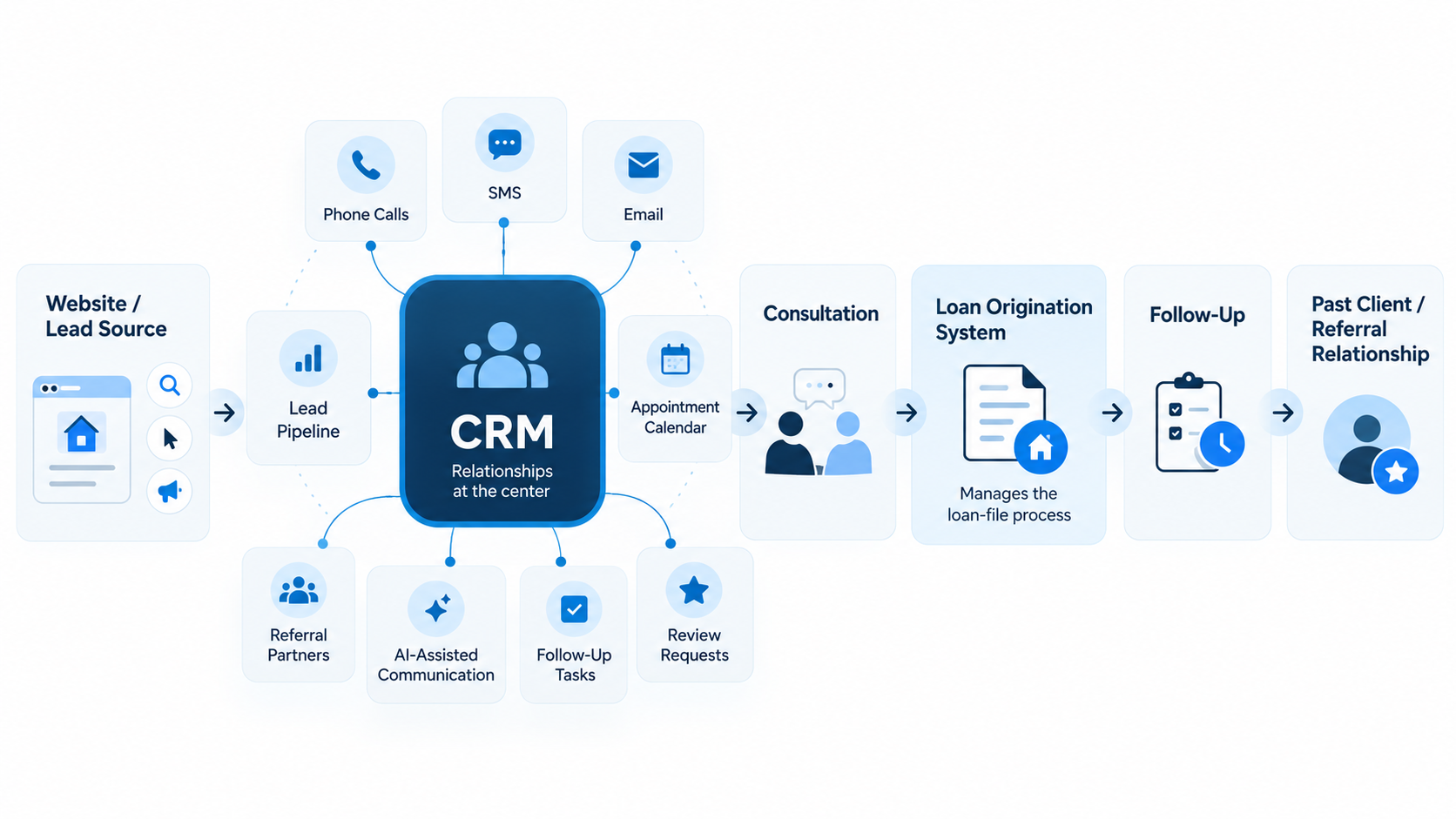
Operational Priorities
CRM Features That Matter More Than a Huge Feature List
Communication History
A clear record of appropriate calls, texts, emails, notes and tasks can help the team understand what has already happened before responding.
Pipeline Visibility
The CRM should make relationship stages understandable without implying that a marketing pipeline is the same thing as the authoritative loan-file status.
Long-Term Nurture
Mortgage relationships do not always move immediately. The system should support relevant follow-up over time without flooding prospects with repetitive automation.
Referral Organization
Borrowers and referral partners are different relationship types. The CRM should make it possible to segment, attribute and manage them appropriately.
Scheduling & Tasks
Calendars, reminders and clear task ownership can reduce unnecessary back-and-forth and make the next human action easier to see.
LOS Connectivity
When integration matters, verify actual data movement, supported objects or fields, direction of sync, timing and exception handling rather than relying on an integration logo alone.
Consent Controls
Communication systems should support the business's consent, preference and opt-out processes, but software controls do not by themselves make a workflow legally compliant.
Permissions
Not every employee or connected automation needs access to every piece of borrower information. Role-based access and sensible data boundaries matter.
Reporting
Useful reporting should help answer operational questions such as where inquiries originate, how follow-up is being handled and where prospects are waiting for a next action.
Quick question: Is a mortgage CRM the same as an LOS?
No. A CRM primarily organizes relationships and communication. The LOS manages the loan origination and loan-file process; verify the responsibilities and connections of each system.
AI & Automation
How AI Should Fit Into a Mortgage CRM
AI can be useful in a mortgage CRM when the task is clearly bounded and the system has reliable, approved information to work from.
Depending on the workflow and applicable requirements, AI may assist with:
acknowledging an inquiry;
identifying basic intent, such as purchase versus refinance;
offering an approved appointment path;
answering approved general FAQs;
summarizing a conversation for the loan officer;
routing a conversation to the appropriate team member;
creating an internal task;
reminding a team member that follow-up is due; and
helping organize CRM records after a conversation.
That is different from allowing an AI system to independently determine creditworthiness, make an underwriting decision, promise approval, decide that a consumer qualifies for a loan, improvise mortgage terms or present unverified rate or payment information.
The Consumer Financial Protection Bureau's current Regulation B resources address credit-related requirements, while Regulation Z advertising requirements address how credit terms are presented. Those obligations do not disappear because a communication was generated or assisted by automation or AI.
Automation vs. AI Agent
Many mortgage workflows do not need an AI agent.
If an appointment is booked and the business always sends the same approved reminder, normal automation may be enough. If an appropriately configured missed-call workflow sends the same approved acknowledgment after a defined event, that may also be conventional automation.
AI becomes more relevant when the system has to interpret what the customer is asking before selecting an approved next action.
Even then, the goal should not be maximum autonomy. In mortgage, clear permissions, defined boundaries and human handoff matter.
Long-Cycle Relationships
Borrower Follow-Up Without Becoming Automated Noise
Mortgage prospects are not all on the same timeline. One borrower may be actively making offers while another is researching options well before a planned purchase.
That is why CRM continuity matters—but continuity is not the same as sending more messages.
Useful follow-up considers:
whether the person has provided any consent required for the communication channel being used;
what they previously asked about;
whether the information is still relevant;
whether an automated message or human conversation is more appropriate;
whether the customer has opted out or changed communication preferences; and
whether specific mortgage terms or claims require additional review.
For commercial email, the Federal Trade Commission's CAN-SPAM guidance explains federal requirements for commercial messages. For certain automated calls and texts, FCC guidance addresses consent and consumers' ability to revoke consent.
A Different Relationship Type
Referral Partners Need a Different CRM Workflow
A Realtor, builder, financial professional, past client or local referral source should not automatically be treated like a borrower lead.
A useful CRM can help distinguish relationship types, document source attribution, maintain notes, create appropriate reminders and make it easier to understand which partners are connected to which opportunities.
That does not mean every partner communication should be automated. Relationship-driven mortgage businesses may use automation for routine administrative reminders while reserving relationship-building conversations for the people responsible for those relationships.
Co-marketing, referral arrangements and communications involving settlement-service relationships can carry additional requirements. CRM functionality should not be interpreted as approval of a particular referral, marketing or co-marketing arrangement.
Compliance & Data
A CRM Does Not Make a Mortgage Workflow Compliant
Software can provide controls, records, permissions and opt-out tools. Compliance still depends on how the system is configured, what is communicated, what consent exists, who is using it, applicable licensing, jurisdiction and actual business practices.
This article is operational guidance, not legal advice. Mortgage businesses should have their own compliance and legal professionals review regulated communications and workflows.
Mortgage advertising
Regulation Z includes requirements governing mortgage advertising, including how certain specific credit terms are presented. Businesses should review automated content carefully when it references rates, payments, fees or other loan terms.
Automated calls and texts
FCC rules under the Telephone Consumer Protection Act regulate certain automated calls and texts and address consumers' ability to revoke consent. A CRM's calling or texting functionality does not eliminate the need to determine whether the business has the consent required for the communication being sent and to honor applicable opt-out requests.
Borrower data
Mortgage brokers and non-bank mortgage lenders can also be subject to federal financial privacy requirements. The CFPB's Regulation P resources address privacy notices and limits on certain disclosures of nonpublic personal information.
That is one reason a marketing CRM should not automatically become a repository for every piece of information associated with a mortgage transaction. Decide deliberately which system needs which information and which users or automations should be able to access it.
What Mortgage Professionals Are Asking
The CRM Conversation Is Moving Beyond Feature Lists
Useful questions to consider include:
Do I actually need a mortgage-specific CRM?
Should my CRM connect directly with my LOS?
Can one platform replace separate texting, email, calendar and funnel tools?
Will an all-in-one platform require too much customization?
How do I keep long-term nurture from sounding like repetitive drip marketing?
Can AI respond after hours without crossing into mortgage guidance that should be handled by a licensed professional?
How should Realtor and other referral relationships be tracked?
What information belongs in the CRM instead of the LOS?
How much automation is useful before the borrower experience becomes impersonal?
Will the loan officers on the team actually use the system consistently?
Those are better questions than asking which platform has the longest feature list. They focus on system boundaries, adoption, communication quality and operational fit.
Selection Framework
How to Narrow the Mortgage CRM Decision
Before comparing demos, define the business requirements in ten areas:
Brokerage size: solo originator, small team, branch structure or enterprise lender.
Existing LOS: which system owns the mortgage file and what CRM connectivity is actually needed.
Lead sources: website, paid media, referral partners, purchased leads, past clients or mixed channels.
Relationship duration: how much long-term nurture is genuinely useful.
Referral model: whether partner relationships need their own segmentation and follow-up structure.
Communication channels: phone, SMS, email, web chat, calendar and other approved touchpoints.
Automation requirements: which repetitive tasks need rules-based automation and where contextual AI may be appropriate.
Compliance requirements: consent, disclosures, approved content, permissions, retention and supervision.
Integrations: LOS, POS, pricing tools, calendars, lead sources and other systems that must exchange information.
Team adoption: whether the people responsible for the borrower relationship can realistically use the system every day.
Once those requirements are clear, the category choice usually becomes easier. A mortgage-native CRM may be appropriate when industry workflow and LOS connectivity dominate the decision. A broader automation platform may be appropriate when lead management, communication and marketing infrastructure are the larger gaps.
Agency AI Lab
The CRM Is One Layer of the Customer Journey
Agency AI Lab's Found First system connects visibility with the systems that handle inquiries after they arrive: CRM, booking, text-back, follow-up, reviews and appropriate AI-assisted communication. The objective is a managed system around the customer journey, not another disconnected software subscription.
Explore Automation & AI Agent Services
Frequently Asked Questions
Mortgage CRM FAQ
Do mortgage brokers need a mortgage-specific CRM?
Not always. A mortgage-specific CRM may make sense when deeper LOS connectivity, mortgage terminology, industry workflows or enterprise controls are priorities. A broader CRM and automation platform may fit when the larger need is lead capture, communication, booking, nurturing and marketing automation around an existing mortgage stack.
What is the difference between a mortgage CRM and an LOS?
A CRM primarily manages relationships, communications, prospects, referral partners, follow-up and marketing workflows. An LOS manages the mortgage origination and loan-file process. Some products connect or overlap, but the two roles should not be casually treated as identical.
Is GoHighLevel a mortgage CRM?
HighLevel is a general sales, marketing and automation platform rather than a mortgage-specific LOS. Mortgage businesses may use it for CRM pipelines, forms, websites, texting, email, calendars, workflows, reputation management and AI-assisted communication, but mortgage-specific integrations and workflow requirements should be evaluated separately.
Can a CRM automate missed-call follow-up?
Some CRM and automation platforms support workflows that respond after a missed call. Whether and how automated texts or calls should be used depends on the communication method, consent, configuration and applicable requirements.
Can AI qualify a mortgage lead?
AI can help collect basic intent and route an inquiry—for example, whether someone is interested in a purchase or refinance or wants to schedule a consultation. That should not be confused with determining creditworthiness, underwriting a loan, promising approval or independently offering mortgage terms.
What should happen to old mortgage leads and past clients?
A CRM can help keep appropriate records organized and support relevant long-term communication where the business has a lawful basis and any required permission to contact the person. Past clients, inactive prospects and referral partners should not automatically receive the same messaging.
Continue Researching
Related Agency AI Lab Resources
HighLevel Review and CRM Features
Explore Agency AI Lab Automation & AI Agent Services
Explore Website and Visibility Services
Sources and Current Product Details
Product capabilities should be confirmed directly with each vendor. See BNTouch integrations, Aidium integrations, and HighLevel pricing and features. Reviewed October 12, 2026.
Trusted Resources
AgencyAILab.com · CertainlySold.net · FLHomesMagazine.com · ElderPlacement.agency · Smart-N-Loans.com
